

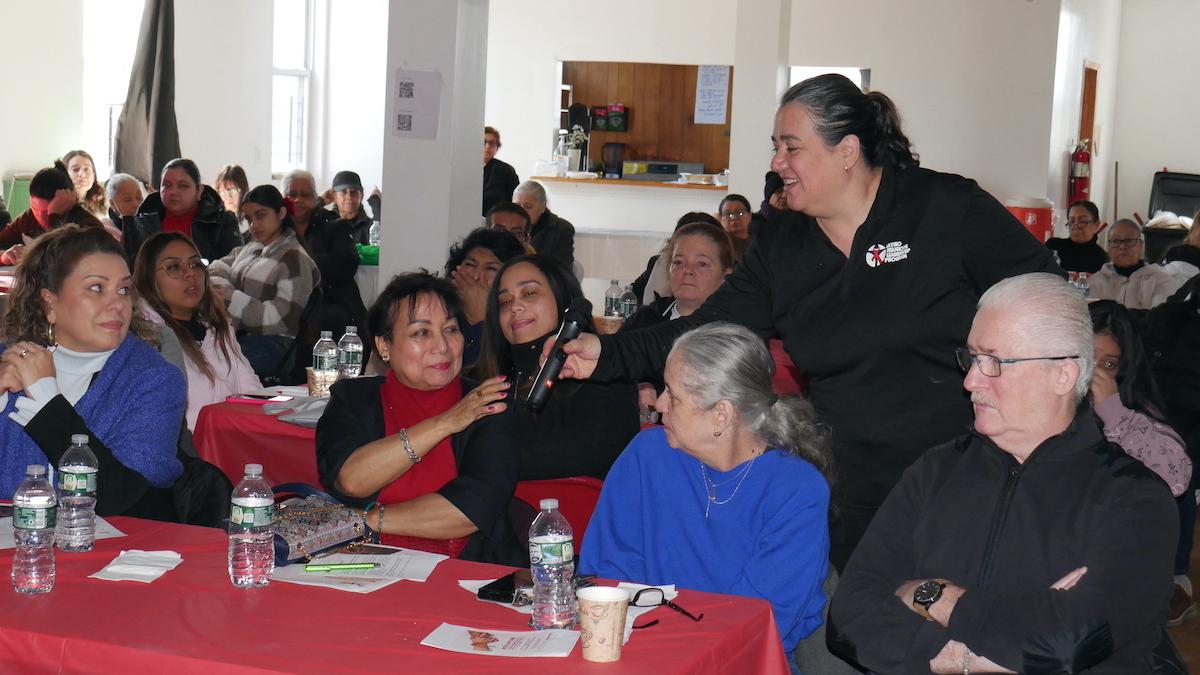
Karina Escamilla is the new Community Mobilization Director at the Latino Commission on AIDS, where she will lead the National Latino AIDS Awareness Day (NLAAD) campaign. Born in Mexico City, Karina earned a bachelor’s degree in Communications Sciences from Universidad Iberoamericana and a specialization in Cinematography from the Universidad Nacional Autónoma de México (CUEC). Throughout her film career, social issues have been—and continue to be—her driving passion.
How did you start working in the health education field?
I started working in health education through the Ventanilla de Salud program at the Mexican Consulate in New York City. That experience was very meaningful because it allowed me to see firsthand how important it is for people to have health information that is accessible, culturally relevant, and in their own language. I quickly learned that health education is not just about sharing information—it is about building trust, listening, and creating meaningful connections.
It has been 18 years since Ventanilla. Dedicating almost two decades to this field has only deepened my passion for working with the community, for the community.
How do you make community leaders work with you?
Over the years, I have learned that you cannot reach people from behind a desk. You have to go where people are, listen to their needs, and build relationships. My approach is simple but intentional: meeting local leaders face-to-face, visiting their workplaces, following up with phone calls, and always letting them know that they can reach out to me.
Your recent work has focused on providing HIV education to mostly Spanish-speaking Latino communities of faith. What is something most people do not know about this population?
One misconception is that we cannot talk about HIV in churches. At the end of the day, HIV is a health issue, and church leaders and members care about the health and well-being of their communities.
For me, the first step is breaking the stigma. I have found that when we talk about HIV alongside other health issues that affect our communities, people become more comfortable. We remind them that HIV can affect anyone, and that prevention, testing, and treatment are available. Once the stigma is reduced, people are more open to learning, asking questions, and taking care of their health.
There are many awareness days for many health issues. Why do you think NLAAD is important?
NLAAD is important because it turns awareness into action. HIV continues to impact our communities, and too many Latinos still lack access to testing, prevention, and treatment information. NLAAD brings trusted local organizations together and gives communities a platform to connect people with the information and resources they need.
Do you see many Latinas taking the HIV test?
Not as many as I would like, but I do see them, and I would love to see many more. I think we need to make HIV testing feel like a normal part of taking care of our health, not something surrounded by fear or stigma.
For many Latinas, having information in Spanish and access to testing in a safe, welcoming, and judgment-free environment can make a big difference. When women feel comfortable asking questions and talking openly about their health, they are more likely to take that important step and get tested.
If the Department of Health and Human Services (HHS) asked you to provide one HIV policy recommendation, what would you say?
I would say: make HIV testing and prevention easier to access in trusted community spaces. If we bring services closer to people and remove language and stigma barriers, we will reach more people earlier and connect them to the care and prevention tools they need.
Where do you want to take NLAAD? What should local organizations expect from you?
My vision is to make NLAAD bigger, stronger, and even more connected to our communities. Local organizations can expect me to stay connected, listen, support them, find resources, and bring more organizations into the campaign. Most importantly, I want them to know they are not doing this alone. I am very excited about NLAAD 2026 and what we can build together.
What is something unique that people don’t know about you?
I’m a fixer—broken things are my specialty. If something stops working, I actually get excited about figuring out how to fix it, and I have to thank YouTube tutorials for teaching me a lot along the way.
I love the challenge of looking at something that isn’t working and thinking, “Okay, how can I fix this?” I guess it’s also how I approach my work: I believe there is always a solution. Sometimes, you just have to be curious enough to find it.
The most difficult question… Tina Turner, Selena, or Madonna?
Difficult decision, but I will go with Tina Turner. I love what she represents—strength, resilience, and empowerment. I’ve always admired her energy and the way she carried herself.